Abstract
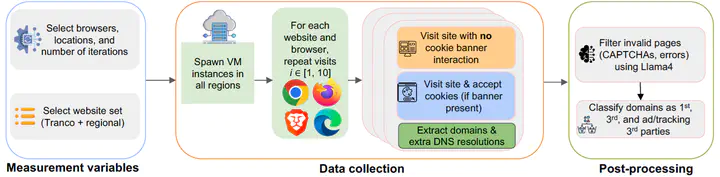
Third-party advertising and tracking (A&T) are pervasive across the web, yet user exposure varies significantly with browser choice, browsing location, and hosting jurisdiction. We systematically study how these three factors shape tracking by conducting synchronized crawls of 743 popular websites from 8 geographic vantage points using 4 browsers and 2 consent states. Our analysis reveals that browser choice, user location, and hosting jurisdiction each shape tracking exposure in distinct ways. Privacy-focused browsers block more third-party trackers, reducing observed A&T domains by up to 30% in permissive regulatory environments, but offer smaller relative gains in stricter regions. User location influences the tracking volume, the prevalence of consent banners, and the extent of cross-border tracking: GDPR-regulated locations exhibit about 80% fewer third-party A&T domains before consent and keep 89–91% of A&T requests within the EEA or adequacy countries. Hosting jurisdiction plays a smaller role; tracking exposure varies most strongly with inferred user location rather than where sites are hosted. These findings underscore both the power and limitations of user agency, informing the design of privacy tools, regulatory enforcement strategies, and future measurement methodologies.